
.png "Hob Learning")
Mar7aba! You have probably met the word Levantine somewhere, on a restaurant menu, in a history book, or inside a language app, and wondered exactly what it covers. It is one of those words that stretches across geography, people, food, and language all at once. This guide walks through every meaning, from the region itself to the Arabic spoken there, in plain and beginner-friendly terms.
What Does “Levantine” Mean?
Levantine is an adjective describing anything connected to the Levant, the region along the eastern shore of the Mediterranean Sea. Depending on context, it can point to the Levantine people who come from there, the Levantine culture of customs, food, and music, or Levantine Arabic, the family of dialects spoken across the region. At its simplest, Levantine just means “from, or relating to, the Levant.”
Where Does the Word Come From?
“Levant” came into English through French and Italian, from the Italian levante, meaning “rising,” a reference to the direction of the rising sun: the East. From the late Middle Ages, European traders, the Venetians especially, used it for the eastern Mediterranean lands they did business with. In Arabic, the region has its own, far older name: بلاد الشام (Bilad el-Sham), or simply الشام (el-Sham). People from the region are called شامي (Shami), and the local Arabic is often called اللهجة الشامية (el-lahje esh-shamiye), “the Shami dialect.” So when you see “Levantine” and “Shami” used interchangeably, they are pointing at the same place from two different languages.
Where Is the Levant?
The Levant has no single official border, and definitions shift depending on the field and who is drawing the map. In everyday use, it covers the territory of modern Syria, Lebanon, Jordan, and the area of Palestine. Some broader definitions also fold in Cyprus, the Hatay region of southern Turkey, and the Sinai peninsula. The historical term “Greater Syria,” which maps closely onto Bilad el-Sham, refers to that core eastern-Mediterranean region before its modern borders were drawn. Because the region’s modern politics are contested, people use these names and boundaries differently, so it helps to notice which sense someone has in mind. Geographically, the Levant sits within the Fertile Crescent, the ancient arc of farmland and trade routes that links Africa, Asia, and Europe, which is a large part of why so many civilizations passed through it.
The Different Uses of “Levantine”
The word does several jobs, and the right meaning depends on context.
Levantine (geography): Relating to the Levant region.
Levantine people: People from, or with roots in, the Levant.
Levantine culture / cuisine: The shared customs and foods of the region, such as hummus, falafel, tabbouleh, and mezze.
Levantine Arabic: The Arabic dialects spoken across the region.
Levantine (archaeology): The prehistoric and ancient peoples of the area.
Levantines (historical): European-descended merchant communities in Ottoman-era port cities like Beirut and Izmir.
Who Are the Levantine People?
“Levantine people” is not the name of a single ethnicity. It describes people from a region where many communities have lived side by side for thousands of years. The majority of Levantines today are Arabs, and the region is also home to Kurds, Armenians, Circassians, Assyrians, Turkmen, and others. It is religiously diverse as well, with Sunni and Shia Muslims, Christians of several traditions including Maronites, Greek Orthodox, and Greek Catholics, alongside Druze, Alawites, and Jewish communities, among others. Most speak Levantine Arabic, while other languages in the region include Hebrew, Kurdish, Armenian, Circassian, and the Aramaic still kept alive by a few small communities.
The roots run deep. The Levant was the homeland of ancient peoples such as the Canaanites, Phoenicians, and Arameans, and historical and genetic research suggests many present-day Levantines carry long local ancestry alongside the layers added by later migrations and empires. And the story is not only local: over the past 150 years, millions of Levantines have emigrated, building large communities in Brazil, Argentina, Chile, Mexico, the United States, Canada, Australia, and France, where descendants often keep the food and the phrases alive at home. That worldwide Levantine diaspora is part of why the cuisine and the dialect travel so well.
A Short History of the Levant
The region’s past is a near-continuous relay of civilizations, each leaving something behind.
Ancient era: Canaanite and Phoenician city-states traded across the Mediterranean, and one of the world’s earliest alphabets spread outward from the region.
Empires: Assyrians, Babylonians, Persians, Greeks, and Romans ruled in turn, raising monuments like Petra, Palmyra, and Baalbek.
Arab conquest (7th century): Arabic gradually became the main language, and Damascus rose to become the capital of the Umayyad caliphate.
Crusades and later dynasties: Crusader states gave way to Ayyubid and Mamluk rule.
Ottoman period (1516 to 1917): Four centuries of Ottoman rule shaped the region’s cities, trade, and kitchens.
20th century: After the First World War, the region was divided under French and British mandates, which laid the groundwork for today’s borders.
Levantine Culture
If one thread ties Levantine life together, it is generosity. In a Levantine home, guests are offered coffee, tea, sweets, and a loaded table, usually more than once, and you will hear tfaddal (“please, go ahead”) and sahtein (“bon appétit”) before you have even sat down. That warmth is the culture’s signature.
The food is its most famous export. Mezze, the spread of small plates, brings hummus, baba ghanoush, and tabbouleh, while the mains run to falafel, shawarma, kibbeh, maqluba, and Jordan’s beloved mansaf. Bakeries turn out manakish topped with za’atar and fresh saj bread, and the sweet table carries kunafe, baklava, and ma’amoul. Much of it overlaps with the wider Mediterranean diet, which is part of why Levantine food has found fans worldwide. Our guide to Levantine food goes deeper if your curiosity is running hungry.
Beyond the table, Levantine music leans on the oud and the mijwiz, and gatherings come alive with the line dance called dabke. The region has given the world towering cultural figures, from the singer Fairuz to the poets Khalil Gibran, Mahmoud Darwish, and Nizar Qabbani. And its landmarks are a roll call of UNESCO World Heritage sites: Petra in Jordan, Baalbek and Byblos in Lebanon, Palmyra and the Old City of Aleppo in Syria, and the Old City of Jerusalem.
What Is Levantine Arabic?
Levantine Arabic is the family of spoken Arabic dialects used in everyday life across Syria, Lebanon, Jordan, and Palestine, and tens of millions of people speak it as their mother tongue. You will hear it called Shami Arabic (عربي شامي), the Levantine dialect, or simply “Levantine.” The key thing to understand is that it is a spoken language, learned at home and used in daily conversation, while Modern Standard Arabic (MSA) is the formal written language of news, books, and schools. Nobody grows up speaking MSA at home, which is exactly why learners who study only the formal version can still struggle to follow a real conversation.
The Two Main Branches
Levantine splits into two broad branches, with plenty of city and village accents inside each.
Northern Levantine: Spoken in Syria and Lebanon. It uses hayda (“this”) and has a lilting, melodic rhythm.
Southern Levantine: Spoken in Palestine and Jordan. It uses hada (“this”) and has a different rhythm and vowel pattern.
Levantine pronunciation also shifts by community. Urban speakers often turn the letter ق into a glottal stop (the 2 sound in Arabizi), while many rural and Bedouin speakers pronounce it as a k or a hard g. None of this breaks communication, though, since the branches are mutually understood.
Levantine vs. Modern Standard Arabic
A few everyday words show just how different the spoken dialect is from the formal written language.
What?: Levantine: shu (شو). Modern Standard: madha (ماذا).
I want: Levantine: biddi (بدي). Modern Standard: urid (أريد).
How are you?: Levantine: kifak (كيفك). Modern Standard: kayfa 7aluka (كيف حالك).
Now: Levantine: halla2 (هلق). Modern Standard: al-an (الآن).
Good: Levantine: mni7 (منيح). Modern Standard: jayyid (جيد).
Both belong to the same language and share a deep common core, but they differ in vocabulary, grammar, and pronunciation. Levantine speakers read and write MSA too, mostly in formal settings, while living their daily conversations entirely in dialect.

Features That Make Levantine Arabic Distinctive
A handful of traits give Levantine its character. The present tense takes a friendly b- prefix, so “I eat” is baakol, “you eat” is btaakol, and “he eats” is byaakol. Signature words like shu, biddi, halla2, and yalla pepper everyday speech. The dialect is rich in warm greetings and blessings, from kifak and sabah el-kheir to Allah yeslamak and yislamu eidak, and it leans on friendly fillers like ya3ni, khalas, and wallah that carry a lot of feeling in a single word. Thanks to decades of Levantine television, music, and pop culture, it is also one of the most widely understood dialects across the entire Arab world, which makes it a genuinely practical one to learn.
How to Start Learning Levantine Arabic
Getting going is more approachable than the reputation suggests. Start with greetings, the everyday openers like good morning and how are you that you will use in literally every conversation. Pick up the high-frequency words next, the ones woven through daily speech such as yalla, khalas, wallah, habibi, and inshallah. Listen every day to Levantine shows, songs, and channels to train your ear. Practice speaking early, since even short exchanges with native speakers build confidence fast. And add the alphabet gradually, letting reading support your pronunciation and vocabulary over time rather than blocking your start. Our list of 100 must-know Jordanian and Palestinian phrases is a friendly next step.
Explore, Learn, and Try It Free for 2 Weeks!
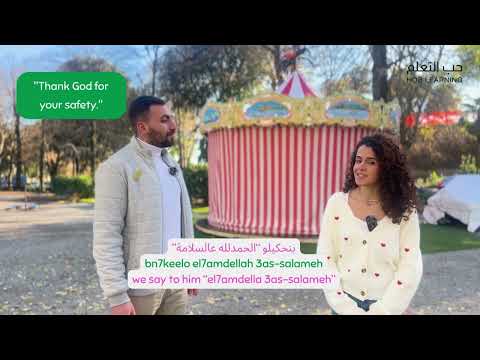
Curious about learning with us? Start with a free course video, then try Hob Learning free for 2 weeks.
Frequently Asked Questions
What does Levantine mean? It means “relating to the Levant,” the eastern Mediterranean region covering Syria, Lebanon, Jordan, and the area of Palestine.
Is Levantine a race or ethnicity? No. It is a geographic and cultural term. Levantine people include Arabs and many other communities.
Is Levantine the same as Arab? Not exactly. Most Levantines are Arabs, but the region also includes Kurds, Armenians, Circassians, and others, and not all Arabs are Levantine.
What is the difference between Levantine and Lebanese? Lebanese is one branch of Levantine. Lebanese Arabic is a single dialect within the wider Levantine group.
What countries speak Levantine Arabic? Syria, Lebanon, Jordan, and Palestine, along with Arabic-speaking communities in the wider region and the diaspora.
Is Levantine Arabic hard to learn? Many learners find it easier to start speaking than MSA, because it is the language of daily life. The sounds written 3, 7, kh, and 2 in Arabizi take a little practice.
Which Levantine dialect should I learn? Choose the one tied to the people you most want to talk to. They are mutually understandable, so what you learn transfers across the region.
In Short
Levantine points to the Levant, a crossroads of civilizations on the eastern Mediterranean, and it describes the region’s people, its culture, its food, and its Arabic, one of the most widely understood dialects in the Arab world. It is a word that carries a whole world inside it, and the best way to meet that world is to start speaking its language.
Ready to try? Hob Learning teaches real Levantine Arabic with native speakers, from your first greeting to real conversation.
👉 Start your free 2-week trial
📱 Download the Hob Learning app on the App Store or Google Play Store
📲 Follow along on Instagram and TikTok