
.png "Hob Learning")
Mar7aba! Spend five minutes around Levantine speakers and one word will keep landing in your ear: wallah (والله). It shows up when someone is telling the truth, when they are genuinely surprised, when they are turning down a third plate of food, and honestly, sometimes just because. It is one of the most used words in everyday speech, and its range is far wider than the textbook translation suggests. So here is the real wallah meaning, and how Levantines actually use it.
What Does Wallah Mean?
Literally, wallah means "by God" or "I swear by God." It is built from Allah with the little oath particle wa- in front, so at its root it is a genuine oath. But in everyday speech it has softened a great deal, and most of the time it is not a solemn vow at all. It works far more like "honestly" "seriously" or "for real" a small word for adding weight, sincerity, or surprise to whatever you are saying, and of course. Think of it as sitting somewhere between a real oath and a conversational filler, with tone deciding which end of that range you land on. It is of course still used as an oath, but it’s clear and understood when that happens, so it isn’t mixed with its other uses.
5 Ways Levantines Use Wallah
As with so much of the dialect, tone does most of the lifting. Here are the five everyday jobs wallah does.
1. To show you mean it. The sincerity use, for when you want to be believed.
والله ما بعرف
Wallah ma ba3ref.
"I honestly don't know."
2. To react with surprise. On its own, with a rising lift, it becomes a question.
والله؟
Wallah?
"Really?!"
3. To refuse politely, especially food. In a culture where hosts offer more than once, a flat "no" rarely sticks, so wallah signals you genuinely mean it.
والله ما بدي، شبعان
Wallah ma biddi, shab3an.
"No, honestly, I'm full." (A woman says shab3ane.)
4. To make a promise or give your word. Here it leans back toward its oath origins, sealing a commitment.
والله بجيك بكرا
Wallah bajeek bukra.
"I'll come to you tomorrow, I promise."
5. To add emphasis or warmth. The expressive wallah, poured over a compliment or a reaction.
والله حلو!
Wallah 7ilu!
"Wow, nice!"
Stronger Forms
Wallah has heavier cousins for when plain emphasis is not enough.
والله العظيم (wallah el-3atheem): "by God Almighty," a serious, weighty version people reach for when they truly want to be believed.
والله vs wallahi: adding the final i gives you wallahi, which is more common in Gulf and Egyptian speech and understood everywhere, though in the Levant the plain wallah is the more typical everyday form.
بالله (billah): used for "please" or "for God's sake," as in billah 3alaik, roughly "I beg you."
A Cultural Note
Wallah is woven through daily life and used by people of every background across Jordan, Palestine, Lebanon, and Syria. Still, it is technically an oath, so some devout speakers prefer not to use it lightly, and swearing by God over something trivial, or over something untrue, is taken seriously. As a learner you are perfectly safe using the plain wallah in relaxed conversation with friends, but hold back the heavy forms like wallah el-3atheem unless you genuinely mean them. This mix of the sacred and the everyday is exactly what makes wallah one of those Levantine words that do not translate cleanly into English, and it keeps good company with inshallah, another everyday expression with a religious root.
A Quick Mini-Dialogue
Here is wallah doing three different jobs in one short back and forth.
Sara: شو، حضرت الفيلم؟ (Shu, 7adarti el-film?) "So, did you watch the movie?"
Omar: والله ما لحقت! (Wallah ma la7a2t!) "I honestly didn't get the chance!"
Sara: والله؟ (Wallah?) "Really?"
Omar: والله! (Wallah!) "Really!"
Notice how the word never changes, but swings from sincerity to disbelief to confirmation purely on tone.
Frequently Asked Questions
Is wallah a bad word? Not at all. It is a religious oath, not a curse, so it is completely acceptable in everyday speech.
What is the difference between wallah and wallahi? They mean the same thing. Wallahi is more common in Gulf and Egyptian Arabic, while wallah is the everyday Levantine form.
How do I respond to wallah? Usually with wallah right back, meaning "really?" or "yes, really," or with sa7i7? ("true?").
Explore, Learn, and Try It Free for 2 Weeks!
Curious about learning with us? Start with a free course video, then try Hob Learning free for 2 weeks.
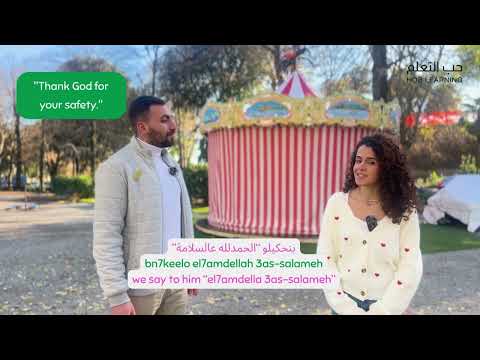
Wallah, Now You Know It
Wallah means "I swear by God," but in daily Levantine speech it is a flexible, warm little word for sincerity, surprise, and polite refusals. The trick is to listen for the tone: a rising wallah asks "really?", while a firm, level one says "I mean it." Catch it at the end of other people's sentences first, then start dropping it into your own, and you will sound a good deal more natural fast. To hear words like this the way real speakers use them, the speak like a native lesson in Hob's beginner course is built for exactly that.
Wallah, give it a try. Start your free two-week trial and learn Levantine Arabic through native speakers and real conversations.
👉 Start your free 2-week trial
📱 Download the Hob Learning app on the App Store or Google Play Store
📲 Follow along on Instagram and TikTok